
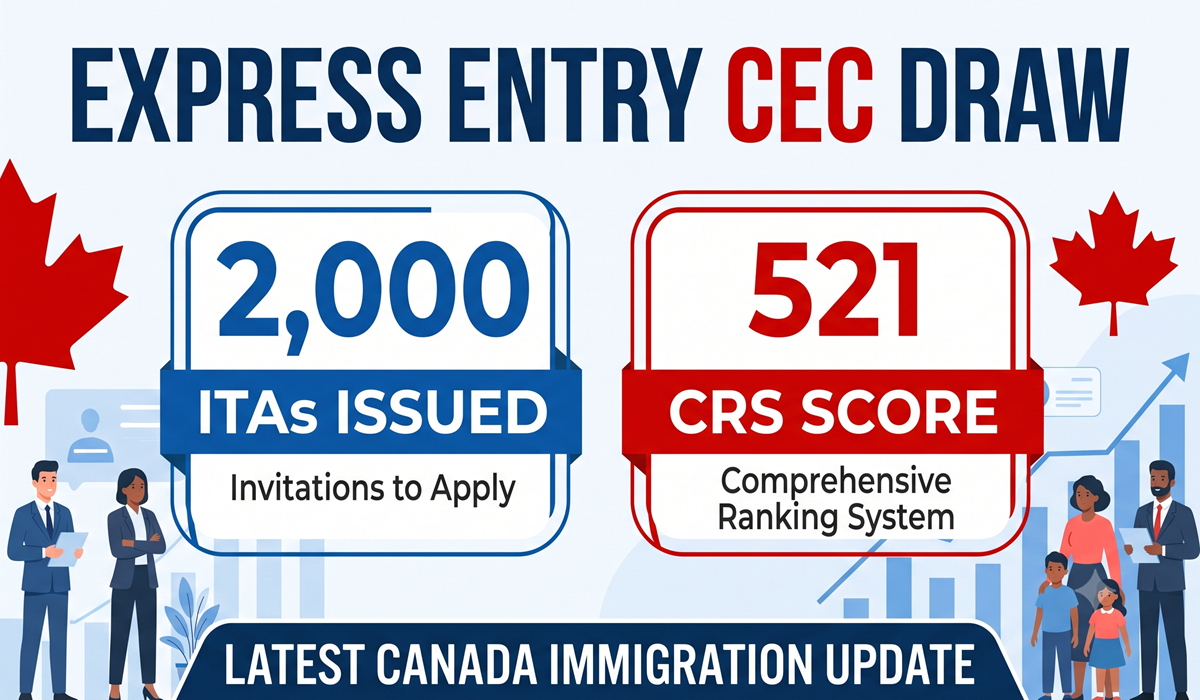
Immigration, Refugees and Citizenship Canada (IRCC) has again moved to support skilled workers already contributing to the domestic economy. In its latest Express Entry round, the federal government invited 2,000 Canadian Experience Class (CEC) candidates to apply for permanent residence — part of Canada’s ongoing strategy to transition temporary residents with in-country work experience into permanent status.
To receive an Invitation to Apply (ITA) in this round, candidates needed a minimum Comprehensive Ranking System (CRS) score of 521. This draw offers a strong path forward for professionals, technical workers, and tradespeople who have already built careers in Canada.
This guide breaks down what the draw means for you: the CRS score requirements, key eligibility criteria, and the step-by-step process for moving from temporary to permanent residency, along with expert analysis on how this draw fits into the broader immigration picture.
What This Draw Means for Applicants
This round is a clear opportunity for skilled foreign workers currently living in Canada. By specifically targeting Canadian Experience Class candidates, IRCC is prioritizing people who have already shown they can integrate into the local labor market and community.
| Draw Metric | Details |
|---|---|
| Program Targeted | Canadian Experience Class (CEC) |
| Number of ITAs Issued | 2,000 |
| Minimum CRS Score Required | 521 |
| Tie-Breaking Rule | Based on profile submission date/time within the pool |
For candidates already in the Express Entry pool, this draw underscores a key trend: the government’s ongoing preference for domestic candidates. If you have at least one year of Canadian work experience, IRCC is consistently carving out dedicated pathways for you.
A minimum CRS score of 521 also shows that competition remains strong but manageable. It’s higher than some historical CEC-specific draws, but notably lower than recent all-program draws, which have often hovered near or above 530. That gives candidates with strong language profiles and solid domestic work histories a realistic window of opportunity.
If you received an ITA in this round, your Express Entry portal status updates automatically. You then have a strict 60-day window to submit a complete, accurate application for permanent residence — missing that deadline means your invitation expires and you’ll need to re-enter the pool.
Canadian Experience Class Eligibility Requirements
To qualify as one of the Canadian Experience Class candidates selected in Express Entry draws, applicants must meet strict statutory requirements set by IRCC. Unlike other economic streams, CEC is specifically built for people with established Canadian ties.
1. Canadian Work Experience
- At least one year of full-time skilled work experience in Canada within the last three years
- “Full-time” means at least 30 hours per week, totaling 1,560 hours over 12 months (equivalent part-time work also counts)
- Work experience must fall under National Occupational Classification (NOC) TEER categories 0, 1, 2, or 3
- Self-employment and work experience gained while enrolled as a full-time student do not count toward CEC eligibility
2. Language Proficiency
Candidates must take an approved language test in English (IELTS or CELPIP) or French (TEF or TCF).
| NOC TEER Category | Minimum Required Score |
|---|---|
| TEER 0 or 1 | Canadian Language Benchmark (CLB) 7 in all four abilities |
| TEER 2 or 3 | Canadian Language Benchmark (CLB) 5 in all four abilities |
Key Takeaways
- Targeted Selection: IRCC invited 2,000 Canadian Experience Class candidates, reaffirming its commitment to in-land applicants.
- CRS Score Baseline: The minimum CRS score for this draw was 521, reflecting a highly competitive applicant pool.
- No Proof of Funds: CEC candidates are exempt from showing settlement funds, simplifying the financial requirements.
- Strict 60-Day Deadline: Successful applicants have exactly 60 calendar days to submit a complete PR application to IRCC.
- Strategic Alignment: This draw supports Canada’s policy of transitioning temporary visa holders into permanent residents.
- Actionable Next Step: Candidates still in the pool should focus on raising language scores or learning French to stay competitive in future rounds.
Frequently Asked Questions
What is the Canadian Experience Class (CEC)? The Canadian Experience Class is an immigration program managed under Express Entry, designed for skilled workers with at least one year of eligible, in-Canada work experience within the past three years.
Can I apply for the CEC if my work experience was part-time? Yes. You need a total of 1,560 hours of work over at least 12 months — for example, 15 hours a week for two years would satisfy this requirement.
Do I need to show proof of funds if I’m invited under the CEC? No. Unlike the Federal Skilled Worker Program (FSWP), CEC applicants don’t need to show proof of settlement funds.
How long are my language test results valid for Express Entry? IELTS, CELPIP, TEF, and TCF results are valid for two years from the test date, and must still be valid both when you submit your profile and when you submit your final PR application.
What happens if my Express Entry profile details change after I get an ITA? Any change — employment status, marital status, language scores — must be updated in your profile. If it drops your CRS score below the draw’s cut-off (521 here), your application could be refused. Double-check accuracy before submitting your final PR application.
Why is the CRS score cut-off so high for this draw? The 521 cut-off reflects the high number of qualified candidates in the pool — many with strong education, language skills, and multiple years of Canadian work experience, which naturally pushes the competitive threshold upward.
Conclusion
IRCC’s latest Express Entry draw — 2,000 ITAs to Canadian Experience Class candidates at a CRS score of 521 — signals its continued preference for skilled, in-country workers. If you received an invitation, act quickly and carefully to prepare your documentation within the 60-day deadline.
If you’re still waiting in the pool, use the time strategically: retake language tests for higher bands, pursue a provincial nomination, or gain additional skilled work experience. A stronger profile now means you’ll be ready the next time your name is called.